Table of Contents
10 Ideas I discovered to achieve balance in my marriage.
My former understanding was that the idea of balance in a marriage was that the husband and wife split the chores, had their calendars aligned and disagreements do not exist. However, over time I have found that it is something much deeper, it is something that exists in those silent parts, in the common looks and in the manner in which we reunite after being in conflict. Balance isn’t a formula. It’s a rhythm. And just like any beat, it requires practice, patience and a great deal of heart.
Finding the Secret of a Happy Marriage.
There are the foundations of my marital balance that I have come to believe and I want to tell you before we discuss strategies. These are not mere ideas, these are experienced.
Trust and Commitment: In my case, I do not only trust fidelity. It is about trusting the partner to turn up even emotionally, even when it is tough. Dedication is to make the decision together, over and over again and particularly on the days when the love is like work.
Shared Values and Goals: We do not need to be in agreement with everything but we need to be moving in the same direction. It is our values that make us stick together whether it is parenting, finances or how we spend weekends.
Mutual Understanding: I have learned the art of listening not only to words, but also to silence. To know the partner, is to know what he/she needs even when he/she is not able to express it.
Emotional Safety: This one is a zero sum game. Without being able to cry, laugh or be vulnerable without fear of being judged, the balance will not be achieved.

The Significance of a Good Communication.
It is not just talking, but the way we remain emotionally attached. I have subdivided it into four pillars which transformed everything in us:
The Four Pillars of Marriage Communication.
- Clarity: Speak kindly tell me.
- Curiosity: Do not make assumptions.
- Compassion: Do not talk badly, particularly during debate.
- Stability: Do not wait until there is a crisis to bridge.
Breaking Down Communication Barriers We would bang against the walls- misunderstandings that degenerated into unresponsiveness. What helped?
Active Listening and Open Communication: I was no longer listening to react but listening to comprehend. That change all by itself subdued so many sharp lines.
There are important aspects of active listening.
- Eye contact
- No interruptions
- Reflecting back what I heard
- Asking, “Did I get that right?”
The Development of Transparent Communication: Transparency is not about exposing myself, but telling what I think, want, and am afraid of. It is saying, I am overwhelmed not snapping.
Check-ins and Marriage Meetings: Once a week Now we do it every week: 20 minutes, phones off, just us. We discuss what is effective, what is not and what we require in more amounts. It’s our emotional tune-up.
Developing Reciprocal Trust and Goodwill: Respect is not only being polite but also the way we care about the dignity of one other.
Realizing Respecting each other: It is how I talk about my partner when he/she is not in the room. It is the way I respect their boundaries, when I do not recognize them.
Support: Support has a different appearance each day. Sometimes it’s making tea. It is even defending them in front of the family. In other situations it is simply sitting next to them and not talking.
Practical Tips on How to be Respectful
- Don’t interrupt
- Don’t belittle
- Weaponize vulnerability is not advisable.
- Do rejoice in their victories, even in the minor ones.
Ten Effective tips towards an ideal marriage balance.
Strategy 1: Golden Rule
Marriage is not a scoreboard it is a mirror. The Golden Rule, which is the Golden Rule and to treat your partner the way you would want to be treated is no moral guideline, it is emotional architecture. When such a principle turns into a regular routine, the whole dynamic is reversed to being reactive. It is easy to talk out of frustration in stressful situations.
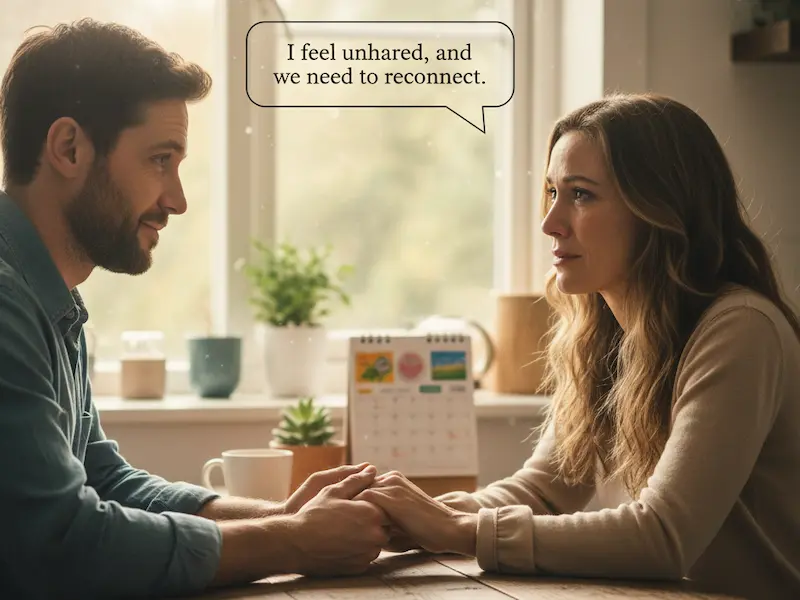
However, in case the Golden Rule comes into play, the reaction eases. The tone is changed instead of saying, You never listen, into saying, I feel unheard, and we need to reconnect. The very shift of that transformation makes war into cooperation. This plan also succeeds in the banal.
It could be in brewing tea when one should not, keeping personal space or just saying thank you- every practice creates a strand in the web of emotional safety. And once both partners start to do it, the relationship starts to be more of a shared sanctuary than a negotiation one. The Golden Rule is not about repressing needs it is about articulating them with the consideration one wants to get back. It is not excellence, but existence.
And in marriage presence means everything. In a world where kindness is the order of the day, it is not a balance that has to be pursued, but rather, it has to unfold by itself.
Strategy 2: Shared Calendar
Balance in marriage falls apart in slow movements. Late arrivals, lost schedules, conflicting schedules. It does not have anything to do with the calendar itself, but with what it signifies, which is respecting each other time, priorities and emotional bandwidth. The thing is that a shared calendar is not merely a tool, but an act.
According to it, Your schedule is important to me. I will not go around you I will go through you. Once it is regularly used by both partners, it is a silent thread which ties their days together. Guessing when somebody is free, no more last-minute confrontation. Just clarity. The magic, however, is when it is the calendar itself that is emotionally connected with.
A promise to add date nights, rest days, or even do not do anything together days, makes it a planner. It is not only a matter of logistics, but it is a matter of will. And where there are disagreements, the calendar makes a level environment. And rather than saying You never told me it is Lets check what we planned. It is that change that can help resentment not establish its roots.
We live in a fast world and keeping up with schedules is one of them saying, We are in this together. It’s not control–it’s care. And care, in exercising daily, is the basis of moderation.
🟠 Strategy 3: Establish Financial Balance
Money often causes the most conflict in relationships—but the conflict is not about money, but about the trust that is felt through money. When one partner spends and the other saves, these are not just two financial styles—they are two emotional languages. And when these languages clash without understanding, there is imbalance in the relationship.
Financial balance does not mean earning or spending equally. It means transparency, respect and sharing. When both partners talk openly—income, savings, debts, desires—a shared reality is created. And trust grows in that shared reality. Creating a budget is an emotional act. It says, “We are together, and we will shape our future together.”
When both partners’ priorities are heard—whether it’s the kids’ education or a solo vacation—neither partner feels invisible. Dignity is the most important thing in financial decisions. If a partner has to repeatedly justify what he bought, he does not feel control, but humiliation. And that is where resentment takes birth.
Balance comes when money is discussed with understanding, not shame. When spending becomes a conversation, not an accusation. And when both partners feel that their financial behavior—not perfect, but honest—is respected, a new stability comes to the relationship.

Strategy 4: Professionally Brew Help
When Necessary Sometimes in a relationship, there is stuff that cannot be solved between two people- there is no lack of love, no lack of work. Nevertheless, there are knots that cannot be opened without looking at it outside. It is here that professional assistance is turned into wisdom and not a weakness.
The use of therapy or counseling is always regarded as the final element although it is a preventive measure. And when a third party, a trained individual, unbiased, listens to what you are saying, he/she is able to discern the pattern that you and you do not notice. And this is where the awareness balance starts.
Professional help implies that you value your relationship to an extent that you are ready to seek external assistance on it. It is an emotional investment, which says, we do not want to rescue this relationship, we want to make it better. And the greatest of all–crisis is not the only need of therapy. It is for clarity.
When the expression is lost, when the pain is still a secret, and then the role of the counselor is to be that mirror according to which both are very clear. Peace is achieved when ego is placed at the backburner and healing is put at the fore. And occasionally, curing starts with an appointment.
🟠 Strategy 5: Find Your Middle Ground
There are two individuals in a relationship one with another background, and one with another emotional style, and one with a different coping mechanism. And when these differences come into collision, one or other of them, or both, usually retreat. But balance is a compromise, and both sides need to be listened to, and none of them should feel unrecognized.
The middle ground is not an area of compromise where there is a loser. It is a bargaining ground in which both are the winners. It is translated as, your needs are legitimate, and mine are too. Let us see a way that does not offend either of us. The important aspect of this plan is the ability to be emotionally flexible. In cases of one partner being loud and the other silent the middle ground is where the former becomes a little quiet and the latter a little less silent.
It is a dance–not a dance of power, but a dance of affection. Middle ground is established when the discussions start with curiosity but not blame. When the question would be, Why do you feel this way? and the question is, I want to know. Balance does not have a predetermined formula. It is a changing document, which is re-written each time there is a dispute. And then alone, when this consensus preserves the dignity of the two, the rapport is really even.

🟠 Strategy 6: Dance to the Flute of Marriage
Marriage is not a fixed form–a moving rhythm. There are times when one of the partners is in the lead, times when the other is in the lead. There are occasions when one becomes lazy, then the second one replaces him or her. And this is the dance–the most organic movement of balance. In this dance, grace is a must.
When one does something wrong correct him lightly. When one retreats, allow them some room. And when someone moves forward, support them. These are all the steps that together create a harmonious choreography. Dance means responsiveness—not reaction. When one partner is emotionally overwhelmed, the other stabilizes him. And when roles change, there is no ego—only rhythm. The most important thing in this strategy is timing.
When to speak, when to remain silent, when to hold, when to release. All this has to be felt—not calculated. Balance comes when both partners view this dance as fluid movements and not as rigid roles. And when this dance goes on even without music, then understand that the relationship has found its beat.
🟠 Strategy 7: Be a Proactive Approach
Imbalance in a relationship is a common scenario where minor aspects are left unattended. Suffering builds up and then one day it explodes into resentment. However, when these signals are early intercepted, there is no root of imbalance. An active strategy implies emotional maintenance.
As we do have frequent check-ups to ascertain our physical health, a relationship also requires frequent attention. This tactic says–do not react, respond. and to answer, it is first necessary to observe. When one of the partners appears a bit remote, inquire, not question, but simply watch. Where there is repetition, deal with it promptly.
And when there is a pain, do not keep it a secret, but take it out there and share it. Being proactive implies that you value your relationship. You do not wait till things go wrong. The steps that maintain balance are taken beforehand. The balancing occurs when a relationship is not allowed to flow passively. As long as the two partners are actively working to cultivate it, the relationship does not just survive, but it thrives.
Strategy 8: Manage Child- focused
Interactions Tension between parenting and partnership is usually ignored. Children also form a component of the relationship but when the entire attention is given to them, the couplehood gradually becomes non-existent. And this is where disequilibrium arises. Balance implies, attaining the satisfaction of the needs of the children, as well as cultivating the relationship which brought them into being.
By only becoming Mom and Dad the two partners begin to lose the warmth associated with being a partner. Intentional couple time is the most crucial element in this strategy. It will be a 30-minute walk or the time spent at an unbroken dinner- these are the times when people are not talking about the kids, but about one another.
Here is where emotional intimacy breathes life once again. Having a balance of child-focused interactions entails boundary setting. It is educating children that the relationship between their parents is also sacred. And when children are taught this respect, they also create emotionally healthy relationships in their adulthood. The balance is achieved when parenting and partnership do not conflict but complement each other. And when equality in roles is accorded to the two, the relationship does not only endure, it thrives.
🟠 Strategy 9: Respect Individual Needs
A relationship has two people, and every person’s emotional metabolism is different. Someone wants to talk immediately after a conflict, while another wants space to process. One is social, another is inward. Balance means understanding these differences—not fixing them. Respecting individual needs means considering personal space sacred.
When a partner says, “I need to be alone for a bit,” it shouldn’t be taken as a rejection. It’s an emotional reset—not a withdrawal. Social preferences are also delicate in the same way. One partner wants to go to every gathering, while the other is an introvert. Balance comes when both their comfort zones are honored, and no one feels guilt or pressure.
It is most important to understand emotional processing styles. If one partner expresses with tears and the other with silence, both must be validated. Neither way is “wrong”—it’s just different. Balance comes when differences are celebrated, not tolerated. When the relationship is based on fluid understanding, not rigid expectations. And when each partner feels accepted with their entire identity, the relationship is truly balanced.
Strategy 10: Help Each other have Dreams
Every human being possesses some wants within him-some loud and some quiet. And when these dreams are disregarded or ridiculed, then that individual gradually begins to lose. However, when one partner helps the other to nurture their dreams, he not only authenticates the dreams but the individual too. Support does not only involve encouragement but also involvement.
When one says, I want to do this, say, how can I help. It turns into an emotional relationship- not only romantic. Dreams, whether practical or poetic have to be respected. It is a business idea, a solo trip, an art form, either way, when a partner takes it seriously, then the dream becomes a collective vision. And most significant of all–support is to give with no comparison.

Conclusion
Striking an ideal balance in marriage is a process that cannot be finished overnight and it needs commitment, patience and mutual desire to develop. These ten tips are sure to help you mend your relationship to be a harmonious partnership that is based on mutual respect, effective communication, and shared goals. It is important to keep in mind that not all marriages are the same and it might take time and patience to discover the right balance.
When you are taking this step towards improving your relationship, you should consider changing these methods to better meet your needs. Dance with marriage, one another, at the same time helping one another with dreams and building upon the personal growth. There is nothing wrong with turning to professional help when required, since outside assistance will give some helpful tips and techniques on how to sustain a good relationship.
Make a first step today and change your marriage to bring positive changes that will be lasting. Your determination to have a complete and satisfying relationship will not just make your lives better but also an example to the rest. Here would be to a happier and more peaceful marriage in 2025 and many years to come!
FAQ
What are some of the ways of balancing marriage when both the partners have different shifts?
Adjust to the various work schedules by designing specific overlap times, communicating through digital means, and utilizing as much quality time as possible being spent together. Those who are off at the same time: In order to have regular date nights, make sure that you consistently communicate with each other by making calls or sending messages at those times.
How to the spirituality or religious beliefs contribute to balance in marriage?
The balance of marriage may be enhanced by the similarity of spiritual or religious beliefs that can offer common values, common activities, and decision-making pathway. Nonetheless, it is absolutely essential to respect other beliefs and couples must learn to respect the spiritual path of both partners without conflicting.
What happens when couples need to be balanced through the major changes in life such as the moves or switching of careers?
Major changes can be navigated through open communication, building more flexible adjustment strategies, and encouraging one another to make decisions. Work on common objectives, be patient and ready to review and make changes where necessary during the transition period.
What do some of these indicators show about an imbalance in marriage?
Time management conflicts, where one side always thinks there is not enough time, or there are too many responsibilities to do, feeling always over-loaded, no personal time, loss of emotional intimacy, accumulation of resentment, and unequal decision-making authority are some of the key indicators. Frequent check-ups can be used to detect these signs in good time.